HISTORY
Changes happen
1984
In 1984, Roberto Bailly was studying mechanical engineering at the State University of Rio de Janeiro. At that time, due to his lifelong passion for sailing and in order to finance his studies, he took a job at Cognac Velas. It was his first professional contact with fabrics, sewing machines, and the nautical market.
1986
Disillusioned with the numerous strikes at the University, in 1986 he embarked on an adventure in the United States. He went with a letter of recommendation signed by Arnaldo Paes de Andrade, a partner at Cognac Velas, which secured him a job at Wedekind Sails and Canvas Co. in New York, a business partner of Cognac.
Bailly then became interested in the development of boat canopies, the main product of Wedekind Sails and Canvas. Directly guided by Jack Wedekind, the owner of the New York company, he quickly specialized in the product.
After experiencing the upholstery market in the USA, Bailly decided to return to Brazil the following year and apply the knowledge he had acquired to a new venture: a company specializing in canopies, mainly for sailboats. Thus, BAILLY Nautical Upholstery was born. His contact with Jack Wedekind didn't end there; Bailly returned to NY several times to help deliver his friend Jack's peak season canopy orders, taking the opportunity to improve his knowledge and always returning with new tools and production processes.
1987
From 1987 to 1989, the upholstery shop occupied a small space within the Brazilian Yacht Club. From 1989 to 1993, it moved to his home garage, also in Niterói.
1993
Expansion. With production now catering to a larger volume of boats, Bailly and his small team joined Luiz Amaro Veiga's group at the SKEG sailmaking company, occupying a large space in the city center. There, in addition to BAILLY covers and canopies, they manufactured various items for boats under the SKEG brand. Basically, everything involving boat sewing was produced by the allied teams at this time: sails, upholstery, cushions, curtains, repairs...
1994
In 1994, Luiz Amaro left the business, leasing his company to Bailly, who took over the entire team and focused his efforts on the production of covers, canopies, and upholstery for boats.
Uncomfortable with the fragility of the agreements made by SKEG and the imminent renewal of the lease on the space he occupied, Bailly began an expansion of his home to reclaim the upholstery workshop.
1995
In 1995, the BAILLY nautical upholstery company was founded at its address in the Vital Brazil neighborhood of Niterói. The search for clients with a higher volume of orders also began, focusing on manufacturers and dealers of motorboats and sailboats.
1996
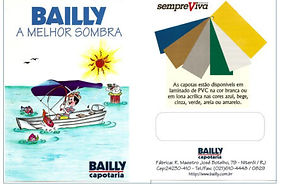
In 1996, the São Paulo company Alpargatas launched the SempreViva acrylic canvas on the national market, creating an opportunity for BAILLY to promote the then-new concept of colored boat canopies in Brazil. The first advertisement for the BAILLY brand was published in Revista Náutica (Nautical Magazine).
1997
In 1997, the success with the acrylic canvas canopy was already complete, but the Alpargatas canvas still needed adjustments. At this time, BAILLY was already supplying important boat manufacturers in Rio de Janeiro such as Real and Runner, and in São Paulo such as Colunna and Flexboat. With a greater focus on boat covers, BAILLY discontinued the upholstery product line.
1998
In 1998, Alpargatas promoted the SempreViva canvas with a stand at the São Paulo Boat Show, giving BAILLY the opportunity to directly showcase its brand and products at the fair. This also occurred at the Rio de Janeiro fairs from 1999 to 2003.
Also in 1998, the domain www.bailly.com.br was created on the Internet and the company became affiliated with ACOBAR (Brazilian Association of Boat Builders and their Implements).
1999
In 1999, BAILLY developed its first exclusive plastic injection molding tool. This marked the beginning of a process of nationalizing nautical upholstery parts and accessories to meet market demand.
It was in 1999 that BAILLY began its partnership with STOBAG awnings, becoming a reseller of the brand in 2001.
2000
In 2000, BAILLY innovated by selling awning covers online. This marked the birth of the Capaleve brand.
2001
In 2001, BAILLY opened its first store at Marina Verolme in Angra dos Reis, where the BAILLY upholstery company was relocated. BAILLY Industrial Ltda. was then founded in Niterói.
2002
In 2002, the STOBAG showroom opened in Itaipu, Niterói, and BAILLY awnings Ltda. was founded, which later, in 2010, was changed to BAILLY nautical Ltda.
2005
In 2005, more space was added to accommodate the growing production with the rental of the land in front of the factory. Where a parking lot previously operated, a warehouse was built to house the metalworking sector.
2007
In 2007, taking advantage of a business opportunity, BAILLY incorporated a new product with the purchase of the assets of
2008
In 2008, the factory was reopened, featuring a product showroom, new offices, and remodeled compressed air, electrical, computer, and telephone networks.
Also in 2008, an important step was taken towards modernizing processes: After visiting the IBEX trade show in Miami, BAILLY joined the MFA (Marine Fabricator Association).
2009
As a result of the wealth of information obtained from MFA partners, a completely new product development process was initiated in 2009. Prototyping software was purchased and part of the technical team was trained in the United States. This marked the beginning of the transformation of projects into a digital, 3D environment.
The company's nautical waterproofs company, RUMO, underwent a complete renovation of its factory. 2010
In 2010, we won the "Outstanding Achievement Award," presented by IFAI, for excellence in design and special application in fabric. The award marks international recognition of the quality and creativity applied to the work developed by the BAILLY team.
In recognition of our management system that encourages the practice of Product Innovation, Posture, and Attitude, also in 2010, we won the SESI Quality at Work Award - PSQT.
2011
In 2011, through an agreement signed with Mr. Eduardo Penido's company, BAILLY was contracted to perform sailmaking services at the Rio de Janeiro Yacht Club, where the production of boat covers was also transferred.
2012
In 2012, operating with four operational units, we began implementing a process management system, which enabled radical performance changes, with greater employee involvement, disciplined methods for analyzing and testing activities, greater strategic robustness, and integration of areas.
As part of the Fluminense Nautical Forum, we participated in the Nautical Industry Training and Innovation Program (PCIN) in Rio de Janeiro, completing the implementation of the 8S program.
Also in 2012, we automated the digitization, cutting, and fabric marking processes with the installation of a brand-new plotter/cutter/digitizer at the factory in Niterói. The equipment guarantees absolute precision and speed in these processes.
And in recognition of our focus on innovation in work models, we were once again champions in the state and regional stages of the "SESI Quality at Work Award" (PSQT).
2013
In 2013, we established an important partnership with the UK company MAKEFAST. This partnership benefits the Brazilian nautical market with high-quality components produced by MAKEFAST, applied to the canopies and retractable roof systems manufactured by BAILLY.
Also in 2013, we debuted as exhibitors at trade shows outside of Brazil, participating in the FORT LAUDERDALE BOAT SHOW alongside MAKEFAST in the United States of America.
2014
An agreement with the American company Glen Raven, manufacturer of Sumbrella acrylic canvas, the most widely used in the nautical industry for making canopies, enabled the direct import of the first batches of canvas in 2014.
2015 and 2016
With the market sluggish due to the crisis, during 2015 and 2016 we experienced a significant reduction in staff and low investment in equipment.
However, we took advantage of the moment for a thorough analysis of the added value of each process, each machine, and each product, which ensured an effective reduction in costs, greater standardization of products, and improved quality. Manuals and work instructions were improved and detailed.
2017 - 2019
Order and progress: Supported by standardization, we began a slow recovery.
2020
Beginning of the COVID-19 pandemic
After the initial shock, we worked intensively on a crisis management plan.
We began implementing a new ERP system that allowed us, in accordance with the process management system, to better plan and integrate activities.
2021
With the nautical market booming due to the new normal, we invested in new equipment and integrated the new ERP with all activities and the online store.
2022
With an increasingly higher level of product standardization and production processes, efforts were invested in increasing technology and automation, combining the history and experience of artisanal methods with advanced technology to innovate more quickly and ensure the accuracy of operations.
2023
With the opening and implementation of a unit in Palhoça-SC, we greatly increased our production capacity, in addition to improving delivery logistics for important clients in Santa Catarina.